
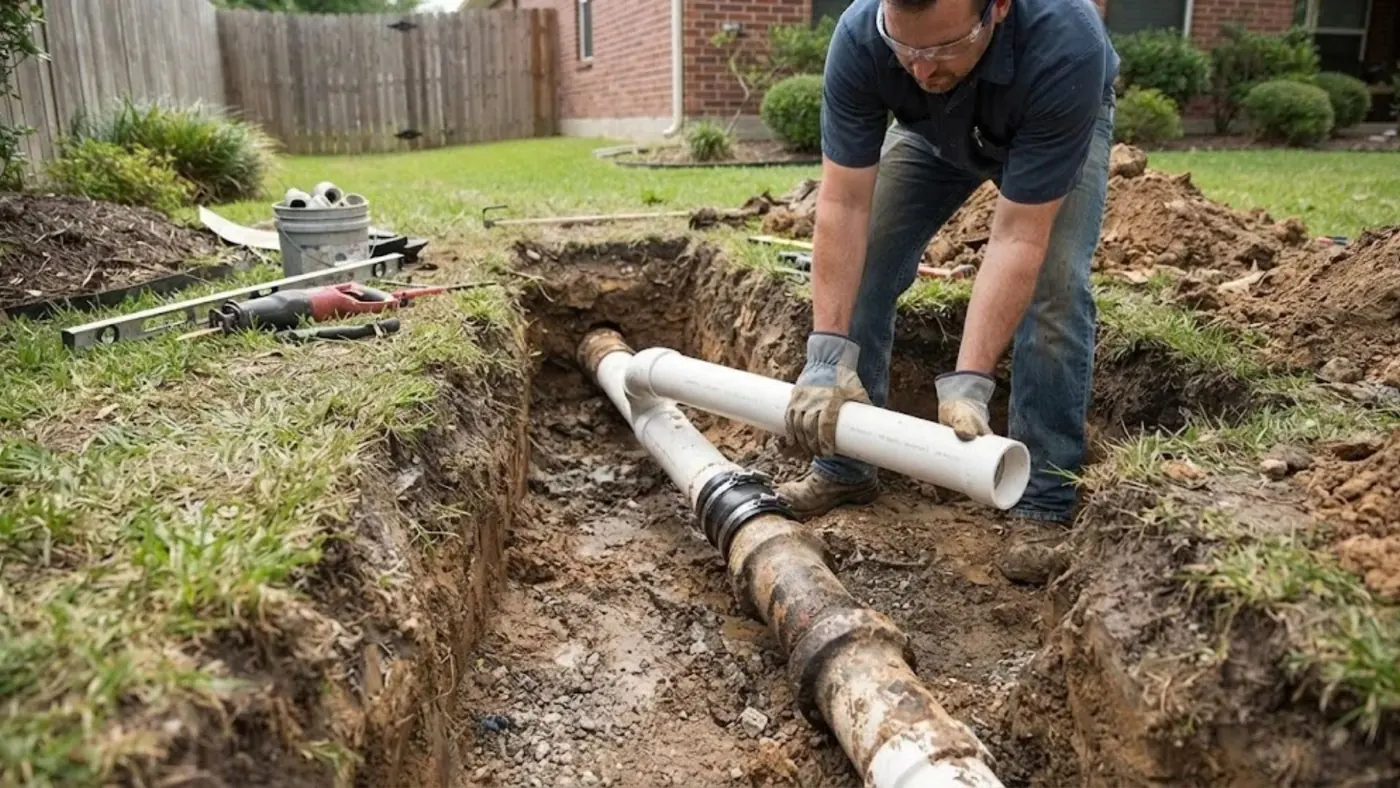
Sewage in a floor drain, a toilet that will not flush and a tub filling from below are the signs of a failing main line, and emergency sewer line repair in Hillside starts with a stop to water use. Do not flush, shower or run the washer. Then call the 24/7 line. We schedule same-day camera work when a plumber is available.
A sewer line that fails is not always a dramatic collapse. Most are slow: a joint offsets, roots work in, a low spot collects waste. The backup is the day the slow problem becomes a fast one.
When a sewer backup is an emergency
Sewage is a health hazard and it keeps rising while fixtures run. Do these things until the plumber arrives.
How we diagnose the line
We run a camera through the cleanout or a toilet flange and watch the pipe from inside. The camera shows roots, an offset joint, a crushed section, a belly holding water or scale narrowing the bore. A locator at the surface marks the depth and the spot so a repair dig, if needed, is small.
This matters because the right fix depends on the failure. A single cracked joint is a spot repair. A line that is cracked end to end is a replacement. Guessing wastes money in both directions, so we show you the footage and explain it.
| What the camera finds | What it means | Likely repair |
|---|---|---|
| Roots through a joint. | Pipe is open at the seam. | Cut roots, then spot repair or lining. |
| Offset or separated joint. | Ground shifted or the pipe settled. | Excavate and replace the section. |
| Belly holding water. | Low spot in the pipe. | Replace the sagging section. |
| Cracked or collapsed pipe. | Old clay or cast iron has failed. | Excavation or full replacement. |
| Heavy scale or grease. | Pipe bore is narrowed. | Hydro jetting, then re-inspect. |
Sewage backing up? Stop water use and call the 24/7 line.
☎ Call (908) 357-1542Repair options: dig, line or replace
Trenchless lining and pipe bursting avoid a long trench but suit only some pipes. They need a line that is continuous enough to line, and a specialist who can say honestly whether yours qualifies. Excavation is more disruptive and it is also the surest fix when the pipe has collapsed or has a bad belly.
- Spot repair: one failed joint or section is cut out and replaced.
- Lining: a resin sleeve is cured inside a sound but leaking pipe.
- Replacement: the whole run from house to the connection is renewed.
- Cleanout installation: gives future access so cameras and jets can reach the line.
Why Hillside lines fail
More than 79 percent of Hillside homes were built before 1960. Many sewer laterals from that era are clay or cast iron, both of which crack, separate or grow a rough interior over decades. Street trees send roots to the joints. Two-family buildings add heavier daily flow to an old pipe sized for less.
Pipe past its working life tends to fail in clusters. If one joint has opened, the neighbors are often close behind. That is why the camera run covers the whole lateral, not only the spot where the backup began.
Who owns which part of the sewer
The lateral from your house to the connection at the street is generally the property owner's responsibility. Ask the Hillside Building and Housing Department at (973) 926-5100 how connection and permit rules apply to your lot before any excavation. Digging in a public street or sidewalk takes municipal approval, and the plumber should not start without it.
What affects the price
- Depth and length of the failed section.
- Pipe material and whether lining is possible.
- What sits above the pipe: lawn, driveway, concrete or a finished floor.
- Whether permits or street work are required.
- Whether the visit is after hours.
You hear the price before work starts. If a line has only a clog and not a failure, drain cleaning is the lower cost first step, and a camera look through sewer inspection tells you which case you have. Many homeowners policies exclude sewer line wear, so ask your insurer, and call (908) 357-1542 for your price.
Standards and sources behind this page
Work described here falls under New Jersey's Uniform Construction Code, whose plumbing subcode is the National Standard Plumbing Code, 2021 New Jersey edition, according to the New Jersey Division of Codes and Standards. Digging also brings in the New Jersey One Call call, which marks buried utilities before excavation.
Permit and inspection steps for a lateral repair are handled by the Hillside Building and Housing Department.
sewer line repair questions from Hillside homeowners
Yes. The line is open 24 hours a day. Stop using water and call (908) 357-1542. A plumber is scheduled for the same day when one is available.
If several fixtures back up at once, a basement floor drain gurgles or sewage rises in the lowest tub, the main line is suspect. A single slow sink is usually a local clog.
Not always. Spot repairs need a small excavation, lining needs only access points, and full replacement needs a trench. The camera result decides.
Policies vary. Many cover sudden backup damage only with an endorsement, and many exclude pipe wear. Check with your agent before work starts.
Roots enter at joints and cracks looking for moisture and then grow inside the pipe. They widen small openings and trap waste, so roots are a common cause of repeat backups.
A spot repair is often finished in a day. Longer runs or street work take more time, and your plumber will give a schedule after the camera inspection.
Call the Hillside Building and Housing Department at (973) 926-5100. They can tell you whether your project needs a permit and inspection.
Sewage backing up in Hillside? Stop water use and call the 24/7 line.
☎ Call (908) 357-1542