
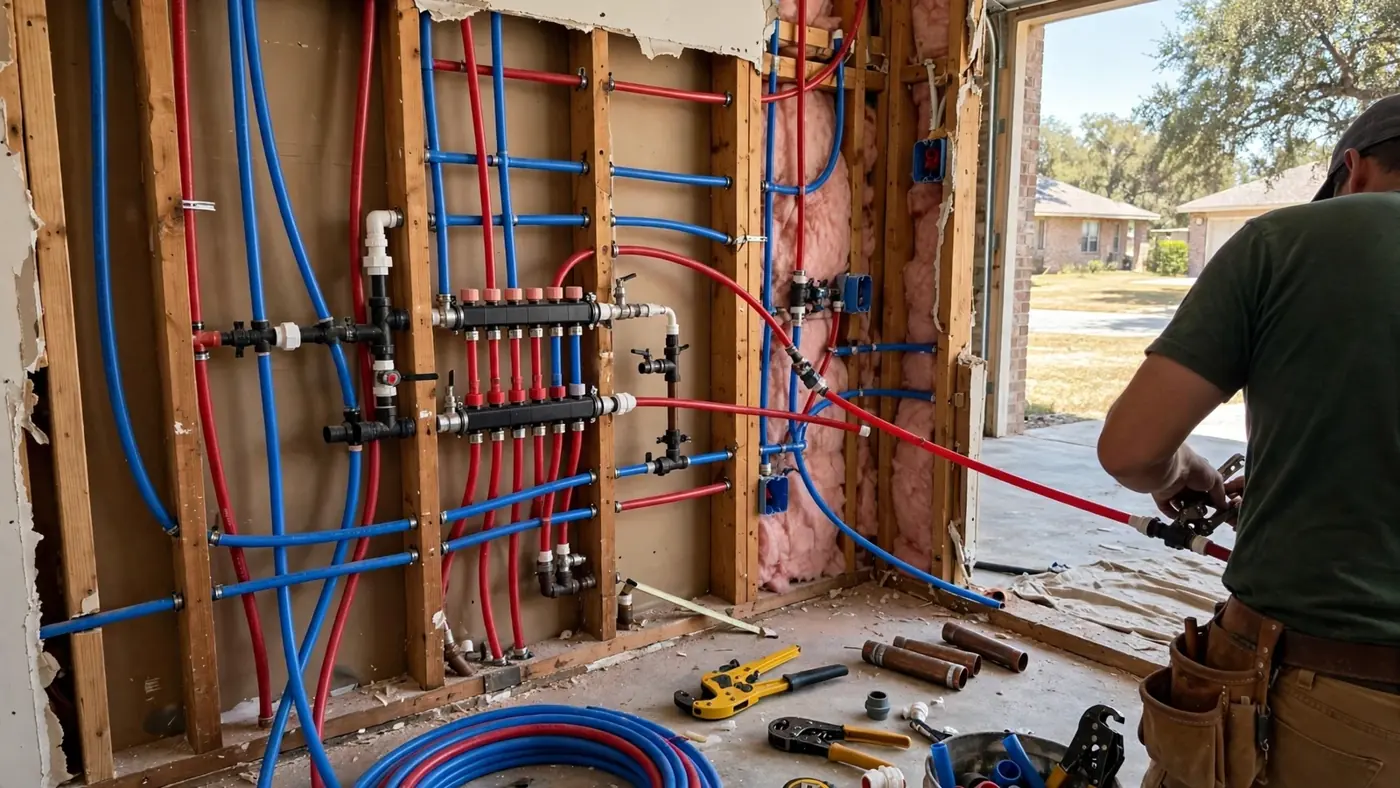
If your water pressure has faded, your hot water runs brown or you have had three pipe leaks in two years, repiping in Hillside may be cheaper than patching. Replacing worn supply pipe restores pressure and stops the cycle of repairs. We say honestly when you need it and when you do not.
Signs your pipes need replacing
- Rusty or brown water from the hot or cold tap.
- Low pressure on multiple fixtures.
- Repeated pinhole leaks.
- Visible corrosion or green stains on copper.
- Galvanized steel pipe, common in houses built before the 1960s.
More than 79 percent of Hillside homes were built before 1960, according to Union County's township profile. Many of those houses still have galvanized steel supply lines in the walls and basement, and galvanized pipe closes up from the inside as it ages.
Galvanized, copper and lead
| Pipe | What goes wrong | What we recommend |
|---|---|---|
| Galvanized steel. | Rust buildup reduces flow, leaks at threads. | Replace the failing runs. |
| Copper. | Pinholes from acidic water, failed solder joints. | Repair spots or replace if widespread. |
| Lead. | Health risk, very old. | Replace, do not patch. |
| PEX. | Newer, rare failures at fittings. | Repair the fitting. |
Repeat leaks or rusty water? Call for a repiping plan.
☎ Call (908) 357-1542Copper or PEX
Copper is long lived and familiar. PEX is flexible, goes in faster and handles a freeze better, so it often means fewer wall openings. Some houses use both. We explain the cost and the tradeoff for each room. See also burst pipe repair for failures you need fixed today.
Partial or whole house repiping
You do not always need the whole house. A bad run from the basement to one bathroom can be replaced alone. If most of the pipes are the same age and material, fixing one only moves the next failure down the line. We inspect and recommend the smallest job that makes sense.
What the job looks like
- Inspect and planWe trace the pipes, check pressure and decide the scope.
- Open accessWe cut small openings in walls and ceilings where needed.
- Run new pipeNew supply lines replace the old, with shutoffs at each fixture.
- Test, patch and clean upWe pressure test, restore water and leave the area ready for drywall repair.
Living through a repipe
Whole house jobs take a few days and the water is off for part of each day. We plan the work to keep one bathroom working where we can. Drywall patching and painting are separate trades, and we tell you where access holes will be so you can plan.
Permits and inspection
Repiping normally needs a permit and an inspection. The Hillside Building and Housing Department at (973) 926-5100 can explain the process for your address.
How to tell if low pressure is the pipes or something else
Before repiping, rule out the cheap causes. A partly closed main valve, a failing pressure regulator or a clogged aerator can all lower pressure. Check pressure with a gauge on an outdoor spigot. Normal household pressure falls in a middle range, and a reading far below it with the main valve fully open points to the service line or the pipes.
If only one fixture is weak, the problem is usually local. If every fixture is weak and the water runs rusty, the pipes are likely clogged with corrosion. That is the case where repiping pays off.
Protecting your house during the work
We lay drop cloths, keep the work area contained and clean up daily. Tell us about fragile finishes such as plaster or old hardwood. In older houses, plaster walls may need extra care, and we choose access points that are easy to patch.
What affects the price
- Pipe material and the number of fixtures.
- Whole house or partial scope.
- Wall and ceiling access and finish repair.
- Permit and inspection.
- Time of day if the job begins as an emergency.
You hear the price before work starts. For your price, call (908) 357-1542.
Standards and sources behind this page
Work described here falls under New Jersey's Uniform Construction Code, whose plumbing subcode is the National Standard Plumbing Code, 2021 New Jersey edition, according to the New Jersey Division of Codes and Standards. The NJDEP lead service line replacement presentation is worth reading if your house is old enough to have a lead service line, since a repipe is a good moment to replace it.
repiping questions from Hillside homeowners
Rusty water, low pressure on several fixtures, repeated leaks or old galvanized pipe all point toward it. We inspect before we recommend.
Partial jobs take a day or two. A whole house usually takes several days, depending on size and access.
We cut small access openings only where needed. PEX often needs fewer, and the openings are left ready for patching.
Both work well. Copper is long lived and PEX is faster and more flexible. We recommend by house layout and budget.
Usually yes. Ask the Hillside Building and Housing Department at (973) 926-5100.
Often yes. We plan the work so water is restored each evening wherever possible.
Repeat leaks in Hillside? Call for a repiping inspection.
☎ Call (908) 357-1542