
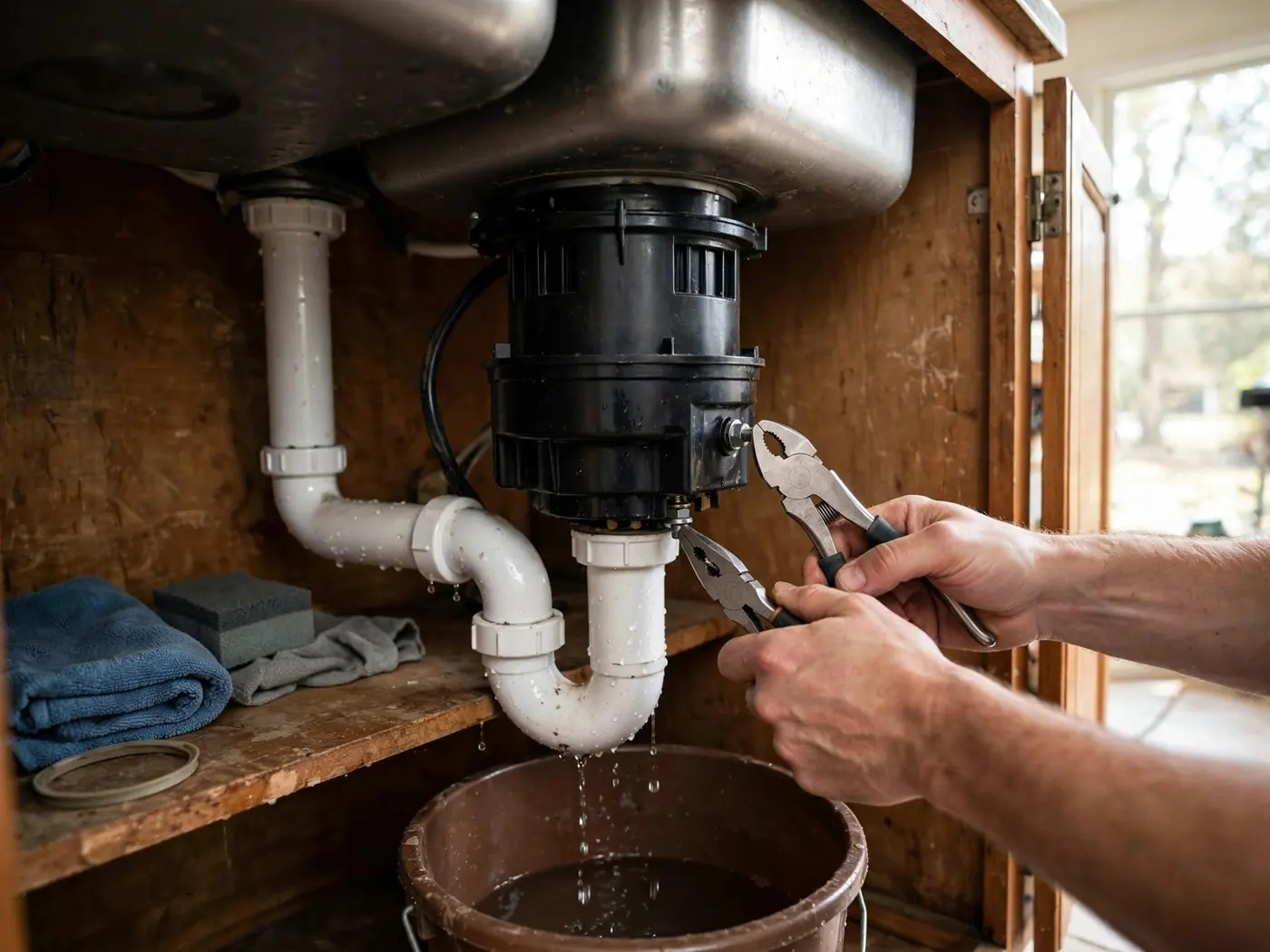
Replacing a garbage disposal is a doable weekend job if the sink already has a disposal and the electrical is in place. Installing the first one under a sink without a disposal is more work. This guide covers the swap and flags the points where a plumber should step in.
Choose the right disposal
| Feature | Why it matters | What to look for |
|---|---|---|
| Horsepower. | Grinds tougher food and jams less. | One half to three quarter HP for most homes. |
| Feed type. | Continuous feed or batch feed. | Continuous is most common. |
| Mount. | The same ring style as your sink. | Check for a quick lock mount. |
| Noise. | Insulation matters. | Choose a unit with sound insulation. |
Match the mount to your sink. Some new disposals fit the old mounting ring and others need a new one. Check the box before you take the old unit out.
Step by step: replace a disposal
- Cut the powerTurn off the breaker and unplug the unit if it is plugged in.
- Disconnect the plumbingPlace a bucket under the trap. Loosen the drain and dishwasher hose connections.
- Remove the old unitSupport it, turn the mounting ring and lower the unit off the flange.
- Prepare the flangeClean the sink opening. Seat the flange with plumber putty or the supplied gasket.
- Mount the new unitAttach the mounting ring, tighten the screws evenly and hang the disposal.
- Reconnect and testReconnect the drain, dishwasher hose and wiring. Run water and check every joint.
Disposal leaking or jammed? Call the 24/7 line.
☎ Call (908) 357-1542Common mistakes
- Skipping the dishwasher knockout, which blocks the dishwasher drain.
- Overtightening the mounting screws and cracking the sink.
- Using too little putty at the flange, which causes a leak.
- Reusing a cracked rubber gasket.
- Wiring with the power on.
If there is no disposal yet
A first-time install needs a switch or outlet under the sink and a drain that handles the extra load. The kitchen drain line must be clear. If the sink clogs regularly, fix the drain through drain cleaning first, because a disposal grinds food but does not carry it away.
When to call a plumber
- No outlet or switch exists and wiring is needed.
- The drain line is old, narrow or slow.
- The sink is stone or composite and could crack.
- The unit is leaking from the body, not a connection.
- You want it done today.
Our garbage disposal repair and installation service handles these jobs.
Tools and parts checklist
- A screwdriver, a hex key and a wrench.
- Plumber putty or the gasket that comes with the unit.
- A new drain tailpiece and trap parts if the old ones are worn.
- Wire connectors and a cord, if the unit does not come with one.
- A bucket and old towels.
What to do with the old unit
Old disposals are heavy and contain a motor. Take them to a metal recycler or ask the township about bulk pickup, and do not leave a heavy unit on the curb without checking the rules. Photograph the wiring before you disconnect it so you can match it to the new one.
Testing for leaks
Fill the sink with a few inches of water, then release it and watch every joint with a dry paper towel. Run the disposal with the water on, and check again. A weep at the flange shows up as a dark ring on the towel. A weep at the drain shows as a drip at the trap.
Deciding between disposal brands and models
For a household that cooks often, a larger motor, a stainless steel grinding chamber and good sound insulation are worth the money. A small kitchen with light use can manage with a basic unit. Check the warranty length, which often reflects how confident the maker is. A longer in-home warranty is a sign of a sturdier machine.
If your sink is a different material
Granite and composite sinks can crack if the mounting ring is overtightened. Stainless steel sinks are easier. Tighten the screws a little at a time in rotation, and stop when the unit is firm, not when your hand tires.
Safety first
Never reach into a disposal, even when it is off. Cut the breaker at the panel rather than trusting a wall switch. Wear eye protection when you work under the sink, because debris and drips fall toward your face. If you are unsure about the wiring, stop and call.
Troubleshooting after installation
- Hums but does not spin: free it with the hex key at the bottom and press reset.
- Leaks at the flange: loosen, add putty and retighten.
- Leaks at the drain: tighten the slip nut and check the gasket.
- Dishwasher does not drain: confirm the knockout plug was removed.
- Smells: scrub under the splash guard.
Most post-install issues are small and fixable in minutes. If a leak continues after you retighten, take the unit off and reseat it rather than adding more putty.
What to know in Hillside
Many Hillside homes were built before 1960, per Union County's township profile, so kitchen drain lines behind the wall may be old cast iron or galvanized pipe. A new disposal can show weaknesses in an old drain.
If wiring is needed, ask the Hillside Building and Housing Department at (973) 926-5100 about permit and inspection rules before you start.
In a two-family house, tell the landlord before changing under-sink plumbing.
Neighbors we serve
We install disposals in Elizabeth and Irvington too, including in older kitchens with narrow drains.
Care and feeding
- Run cold water while grinding and for a few seconds after.
- Cut large scraps into small pieces.
- Keep grease, bones and fibrous food out.
- Grind ice cubes now and then to scrape the walls.
Standards and sources behind this page
Manufacturer instructions set the mounting and wiring steps for each unit. The plumbing connections follow the state code described by the New Jersey Division of Codes and Standards.
Questions Hillside homeowners ask
If the sink already has one and the wiring is in place, many homeowners can. First-time installs often need a plumber or an electrician.
Half to three quarter horsepower fits most households. Larger families may want more.
Usually the flange putty, the mounting ring or a drain connection. Tighten evenly and check each joint.
Wiring or plumbing changes may. Ask the Hillside Building and Housing Department at (973) 926-5100.
About ten years is typical.
Not sure it is a DIY job? Call the 24/7 line and a plumber will tell you straight.
☎ Call (908) 357-1542