
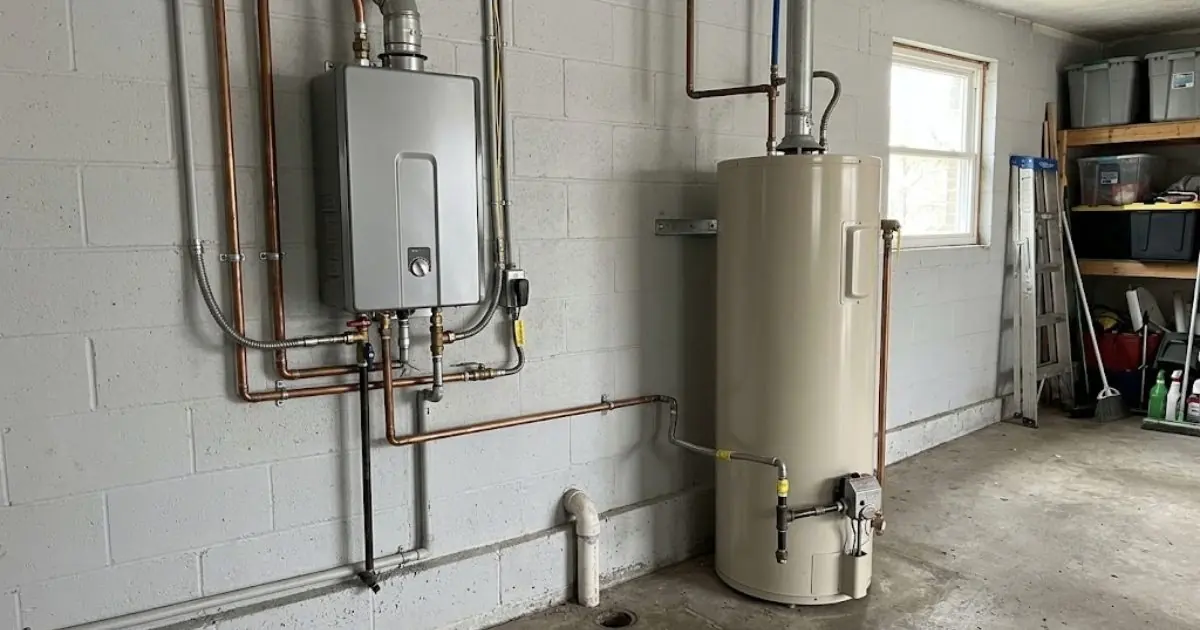
A 40 gallon gas water heater suits a household of about two to four people, depending on how much hot water you use at once. A professional install takes a few hours and includes the gas connection, the venting, the water lines, the relief valve and a safety test. Gas appliance work is not a good place to learn by doing.
Ask about the first hour rating on the label, not only the tank size. That number tells you how much hot water the unit delivers in a busy hour, and it is a better guide than the gallons alone.
Is 40 gallons the right size?
| Household | Likely size | Notes |
|---|---|---|
| One or two people. | 30 to 40 gallons. | Light use. |
| Three or four people. | 40 to 50 gallons. | Two baths used at once may need 50. |
| Five or more. | 50 to 75 gallons or tankless. | High morning demand. |
| Heavy use, soaking tub. | Larger tank or tankless. | Check first hour rating. |
What the installation includes
- Shut off and drainThe gas, the cold water and the old tank are shut off and drained.
- Remove the old unitIt is disconnected and taken away.
- Set the new tankIt is leveled and set in a drain pan where required.
- Connect water and gasWater lines, a gas shutoff and a drip leg are fitted with the right fittings.
- Connect the ventThe flue is sized and sloped correctly and sealed.
- TestWe check for gas leaks, test the burner and verify draft and temperature.
Planning a 40 gallon install? Call for a quote.
☎ Call (908) 357-1542Venting and combustion air
A gas heater makes carbon monoxide. The flue must carry it out of the house with a steady upward slope and tight joints. The room needs enough air for combustion. A water heater in a small closet or a tight basement corner may need a vent or louver. We check draft with a test, not by guess.
A carbon monoxide alarm on each level is cheap protection. Replace the batteries every year and the alarm itself according to its label.
The gas line
The gas line to the heater needs a shutoff valve and a sediment trap, also called a drip leg. The pipe must be sized for the load. We test every joint with a leak solution. If you smell gas at any point, leave the house and call the gas utility or 911 from outside.
Relief valve and drain pan
The temperature and pressure relief valve must discharge to a safe spot through a pipe that runs downward and is not capped. A pan with a drain line under the tank protects the floor if it ever leaks. These details are what separate a safe install from a quick swap.
Permits and inspection
Gas water heater installs commonly need a permit. The permit means an inspector looks at the gas, vent and relief valve. It protects you and your insurer. We follow the code and handle inspections where we can. See water heater installation for more.
What to prepare before the plumber arrives
- Clear a path to the heater and a few feet around it.
- Move stored items away from the unit.
- Know where the gas shutoff and the water main are.
- Plan to be without hot water for a few hours.
- Take a photo of the old unit's label for your records.
Efficiency labels and rebates
Look for the energy factor on the label and the yellow guide tag. Some utilities and programs offer rebates for efficient units, but offers change. Check the utility sites and the manufacturer for current terms before you buy.
Warranty details worth reading
The tank warranty and the parts warranty are separate. Many tanks carry a longer warranty on the tank than on the controls, and some require registration. Keep the receipt, the model and serial numbers and the installation date in one place.
Common mistakes we fix on older installs
- A flue pipe that slopes downward or has loose joints.
- No sediment trap on the gas line.
- A relief valve piped upward or capped.
- Flexible gas connectors that are old or kinked.
- A tank sitting directly on a damp concrete floor.
- Missing seismic or stability supports where required.
When we replace a heater we inspect these items on the old setup and correct them. If the existing vent is corroded, it is cheaper to replace it during the install than to return later.
Costs: what moves the quote
The unit itself, the vent materials, the gas connector, a drain pan, an expansion tank, the permit and any needed pipe changes all go into the quote. A basement with a long vent run costs more than a utility closet. Ask for an itemized quote so you can compare two contractors fairly.
What to know in Hillside
Call the Hillside Building and Housing Department at (973) 926-5100 to confirm permit and inspection steps for a gas water heater. The plumbing subcode official can be reached on extension 322.
Many Hillside homes were built before 1960, per the Union County township profile, so check the age and condition of the existing flue and gas pipe when replacing a heater.
New Jersey American Water supplies Hillside. Ask for the water quality report if you want to know about hardness and sediment.
Neighbors we serve
We install gas heaters in Newark's South Ward and Elizabeth too.
If your heater is failing today
If the old tank is leaking, treat it as an emergency. Shut off the cold water to the tank and the gas, then call. Our emergency water heater replacement is built for that case.
Care after the install
- Set the thermostat at about 120 degrees.
- Test the relief valve gently once a year.
- Flush a few gallons from the drain valve annually.
- Keep the area around the heater clear of storage.
Standards and sources behind this page
Work described here falls under New Jersey's Uniform Construction Code, whose plumbing subcode is the National Standard Plumbing Code, 2021 New Jersey edition, according to the New Jersey Division of Codes and Standards. The same code governs the vent, the relief valve and the gas connection, and the CDC carbon monoxide guidance explains why a working alarm is part of any gas appliance install.
Sizing and efficiency ideas are in the U.S. Department of Energy water heating guide.
Questions Hillside homeowners ask
Usually two to four, depending on how much hot water you use at once.
We advise against it. Gas, venting and combustion air errors can cause fires and carbon monoxide.
Likely yes. Ask the Hillside Building and Housing Department at (973) 926-5100.
A straightforward swap takes a few hours.
Leave the house and call the gas utility or 911 from outside.
Not sure it is a DIY job? Call the 24/7 line and a plumber will tell you straight.
☎ Call (908) 357-1542